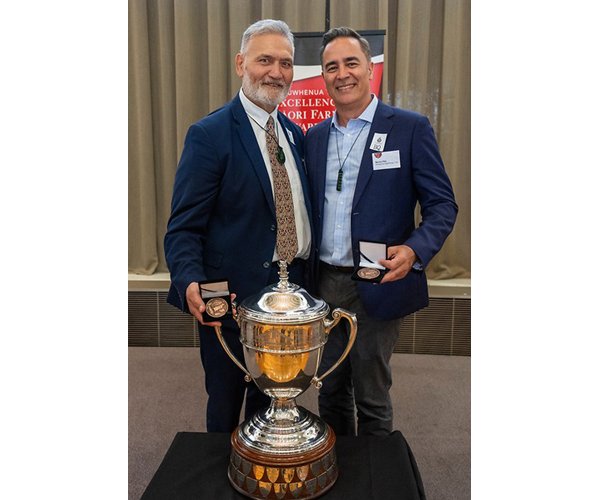
On the photo: L-R: Lester White, Chair, The Proprietors of Tawapata South, Onenui Station; and Morris Pita, Co-Chair, Whangaroa Ngaiotonga Trust
The finalists in this year’s Ahuwhenua Trophy for the top Māori sheep and beef farm were announced at a special function at Parliament today by the Minister of Agriculture, Hon Todd McClay. The finalists are:
- Whangaroa Ngaiotonga Trust; and
- The Proprietors of Tawapata South, Onenui Station
The Ahuwhenua Trophy is the most prestigious award for Māori agriculture and was inaugurated in 1933 by the great Māori Leader, Sir Apirana Ngata and the Governor General at the time, Lord Bledisloe. The objective was and still is to encourage Māori farmers to improve their land and their overall farming performance with an emphasis on sustainability. On a three year rotational basis, the Trophy is competed for by Māori farmers and growers in the sheep and beef, dairy and horticultural sectors. This year the competition is for sheep and beef.
Nukuhia Hadfield, Chair of the Ahuwhenua Trophy Management Committee, says it is fantastic to see these excellent finalists who will add to the impressive alumni created by this award. She says the last few years have been hard for all sheep and beef farmers around the country as they have fought to stay in business against the odds of adverse weather and lower prices, especially for sheep meat.
“Māori farmers have been among the worst affected by the adverse weather given that many are in areas such as the East Coast of the North Island which bore the brunt of cyclone Gabrielle and other heavy rain storms. I live in this region and know first-hand what our communities have endured,” she says.
Nukuhia Hadfield says Māori are intergenerational farmers, meaning that while they want to get their properties up and running as quickly as others, they are equally concerned that any such repairs will be of such good quality as to protect the land for future generations. “A philosophy that is both practical and sensible, and one that is catching on in the wider agri-sector,” she says.
Nukuhia Hadfield says the other encouraging news for Māori was contained in a recent MPI report which shows that the asset base of Māori collectives (trusts, incorporations and other entities but not individual farmers) has risen from $6 billion in 2013 to $19 billion in 2023. She says this data shows conclusively that Māori are a real force in the NZ economy. She adds that the future for Māori-agri is very bright judging by the calibre of rangatahi Māori entering the Ahuwhenua Young Māori Farmer Award. She says every year a new cohort of young people come through this competition and go onto greater things. The names of this year’s finalists will be announced soon.
The finalists in the senior Ahuwhenua Trophy competition will each hold a public field day at their respective properties. Each day runs from 9.00am – 3.30pm and all are welcome. Further details, including start point addresses, will be posted on the Ahuwhenua Trophy website and Facebook page.
Field day dates
- Thursday 3 April – Whangaroa Ngaiotonga Trust
- Thursday 10 April – The Proprietors of Tawapata South, Onenui Station
The winner will be announced at the awards dinner held on Friday 6 June 2025 at Fly Palmy Arena, in Papaioea, Palmerston North.
Media please note:
For further information contact Peter Burke on 021 224 2184 or peterb@actrix.co.nz. For ‘free for editorial use’ photos of competition go to https://rb.gy/6f1bwy and contact John Cowpland from Alphapix for download access on info@alphapix.co.nz.
Our thanks to our valued Ahuwhenua Trophy sponsors:
Platinum: Te Puni Kōkiri and the Ministry for Primary Industries
Gold: Te Tumu Paeroa, BNZ, NZ Mãori Tourism and Beef + Lamb New Zealand
Silver: Ballance Agri-Nutrients and PGG Wrightson
Bronze: BDO, Affco, FMG, Massey University, AgResearch and MBIE
Other: FarmIQ and Kono Wines
A big thanks also to sponsors of the Ahuwhenua Young Māori Farmer Award:
Kaitautoko Tuatahi: Te Tumu Paeroa
Kaitautoko Taketake: Primary ITO, Beef + Lamb New Zealand and Te Puni Kōkiri
Finalist Profiles
Whangaroa Ngaiotonga Trust
Field day: Thursday 3 April 2025
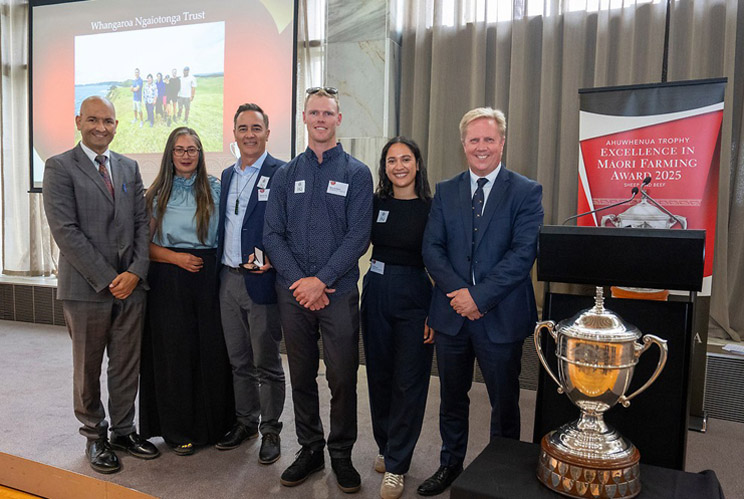
L-R: Hon Tama Potaka; Hūhana Lyndon, Co-Chair; Morris Pita, Co-Chair; Matthew Payne, Farm Manager; Tori Norman, Farm Administrator; and Hon Todd McClay.
Ka tangi a Tūkaiāia, ko Ngātiwai kei te moana e haere ana. Ka tangi a Tūkaiāia ki te whenua, ko Ngātiwai kei te tuawhenua e haere ana. Whangaroa Ngaiotonga Trust manages the Ngaiotonga A3 block, situated an hour’s drive north of Whangārei, nestled in the heart of Whangaruru. It’s whenua is bordered by the Te Moananui a Kiwa to the east and Whangaruru Harbour to the west. Totalling 1,100ha of coastal hill country, it consists of 360ha of effective farmland, 297ha of forestry, and 443ha of native forest and wetlands.
The story of Whangaroa Ngaiotonga Trust is one of loss, restoration and resiliency. Prior to WWII the block was home to numerous Whangaruru whānau dating back to the time of Manaia, the founding tupuna of Ngātiwai. In 1952, the Department of Māori Affairs held a hui for the then 484 registered owners, of whom 70 were present. Even though only 24 signed a resolution in support, the Department went ahead with the consolidation of the whenua into a ‘Land Development Scheme’ which led to an inter-generational disconnection of the people from the whenua. Departmental failures meant that by 1961 the farm’s development debt was already four times its economic value. In the late 1980s government transferred the responsibility for the whenua, with the debt, back to the people, leading in 1988 to the creation of the Whangaroa Ngaiotonga Trust. Within five years, the pressure of the debt left the Trust with little choice other than to lease its land to a third party, disconnecting again the whenua and the people.
What followed was a long period of disputes between the Trust and the tenant over the way the farm was being managed and the wellbeing of the whenua, which were eventually settled by the land being returned to the Trust. With the support of MBIE (PGF), farming consultants AgFirst, and additional tautoko from Te Puni Kōkiri, MPI and Northland Regional Council, the Trust launched its whenua restoration programme. Investment from these agencies enabled the Trust to embark on a complete farm turn around, including 60ha of gorse removal, a 40km network of water pipe supplying 450 micro toughs, 57km of fencing and cell systems, and a new farm roading system. In June 2020 the trust purchased its first heard of 188 steers and set itself the goal of owning a million-dollar herd by 2025 – a target it achieved in 2023 with the support and mahi of its new Farm Manager. The Trust’s wetlands are kainga to endangered birds including the Mataku (Bittern) and the Pāteke (Brown Teal duck). A native replanting programme is also underway to support the taiao after years of neglect.
Together with the support of the people, these steps marked the beginning of the Trust’s whenua reclamation and farming journey, and the establishment of the thriving 1,200 head bull fattening operation the Trust runs today. The farm’s rapid transformation has created employment and enabled the Trust to support Whangaruru Marae, Urupā, Kura and Sports Teams, as well as our next generation of leaders with education grants. Along the coastal bluffs unsuited to beef, sheep have been introduced as a source of kai for hui mate. Community gardening is now getting back underway for the first time since the 1950s, bringing mātauranga back into the kāinga to support community wellbeing. In four years, the Trust has turned its previously struggling farm into a modern and profitable bull operation. Its focus now is on continuing to enhance the farm’s footprint and productivity, and to create further employment by diversifying its landholdings and business portfolio into other areas such as horticulture and eco-tourism. ‘Strong and Successful – People and Land Together’
Media contact: Tori Norman, 021 251 2408, admin@wntrust.onmicrosoft.com
The Proprietors of Tawapata South, Onenui Station
Field day: Thursday 10 April 2025
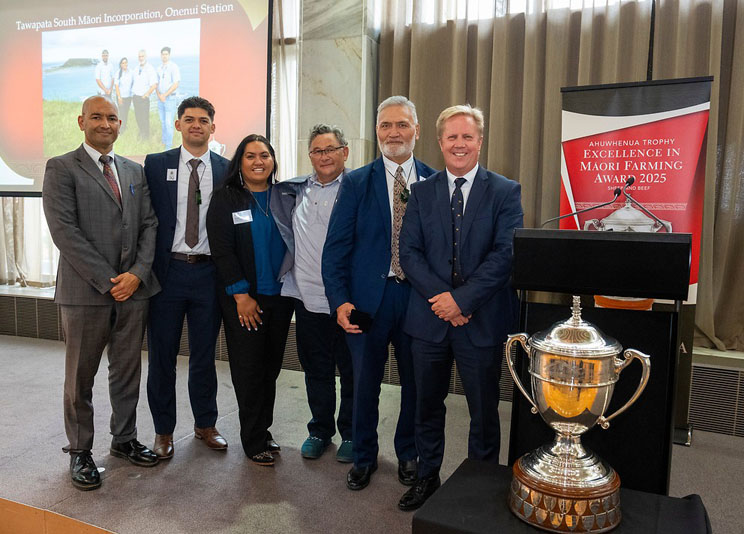
L-R: Hon Tama Potaka; Corban Paewai, Committee Member; Natalie Paewai, Committee Member; Philip Te Hau, Deputy Chair; Lester White, Chair; and Hon Todd McClay.
Tawapata South was discovered in the 10th century by our tīpuna, Tamatea-Ariki-Nui, Ruawharo, and Tūpai – Pacific navigators whose journey from Hawaiki established the whakapapa of our people in this land. Ruawharo founded the first house of learning, Ngāheru-mai-tawhiti, on Waikawa (Portland Island), which became a spiritual centre for the entire East Coast.
Today, The Proprietors of Tawapata South, trading as Onenui Station, is a Māori incorporation located at the tip of the Māhia Peninsula, Hawke’s Bay. Spanning 3,476 hectares, the whenua includes 1,700 hectares of effective farmland and 836 hectares under a Ngā Whenua Rāhui Kawenata.
Governance and Strategic Direction
Tawapata South was incorporated under the Māori Affairs Act 1953 on 21 July 1967. It is governed by the Committee of Management: Lester White (Chair), Philip Te Hau (Vice Chair), Murray MacGregor, Natalie Paewai, and Corban Paewai. The committee provides strategic oversight, balancing sustainable farming while upholding tikanga, kawa, and mātauranga. Our aspirations are guided by the four POU: Tangata, Tikanga, Taiao, and Tahua, shaping our planning and decision-making.
Our mission is grounded in whakapapa, which connects us to our taonga and carries kaitiaki obligations. We manage our relationships to ensure the well-being of our lands, waters, and people. Our strategy is structured over three phases within a five-year plan, allowing us to set, implement, and report key milestones to shareholders and whānau.
Farming Operation
Onenui Station is a sheep and beef farming unit wintering 15,000 stock units, including 6,000 breeding ewes, 600 breeding cows, replacements, and trade cattle. The farm finishes 75% of its sheep and 36% of its cattle, with the remainder sold store. The station comprises 350 hectares of productive flats, with the balance classified as North Island steep hard hill country.
A major development project, initiated in 2016, is reclaiming 1,046 hectares of scrubland for productive use, aligning with the 2006 environmental plan. Erosion-prone areas are managed through fencing, native planting, and long-term sustainability initiatives.
Onenui Station has a total of four employees comprised of a farm manager a shepherd and two fencer generals. The incorporation prioritises employment, upskilling, and community engagement.
Innovation
Since 2016, Tawapata South has been home to Rocket Lab, the world’s first private orbital launch range. This relationship aligns with our strategy to diversify income opportunities while maintaining the integrity of our whenua. Rocket Lab’s presence has brought investment into the region, creating local employment opportunities and fostering innovation. Our ability to integrate traditional land use with cutting-edge technology demonstrates our commitment to long-term sustainability.
Community Relationships
Tawapata South is committed to fostering strong relationships within the community. We provide scholarships to support the education and development of our people. Additionally, we have established a lasting partnership with Kahungunu Marae, where we host our AGM, reinforcing our connection to our whānau and cultural heritage.
Commitment to Sustainability
With 20 kilometres of rugged coastline and diverse landscapes, Onenui Station is committed to sustainable land management. A comprehensive environmental plan protects waterways, coastal dunes, and erosion-prone gullies. Native planting initiatives and fencing projects reinforce long-term environmental resilience. We are deeply grounded in the values that define us – whakapapa, tika pono, manaakitanga, and kaitiakitanga. Tawapata South Māori Incorporation, Onenui Station remains dedicated to preserving its whenua while ensuring a sustainable and prosperous future for its people.
Media contact: Lester White, 022 052 3823, lesterwhite55@gmail.com